Forces
The Five Forces, one article each
Four forces come from outside your organization, one from within. Your AI strategy sits at the center.
-
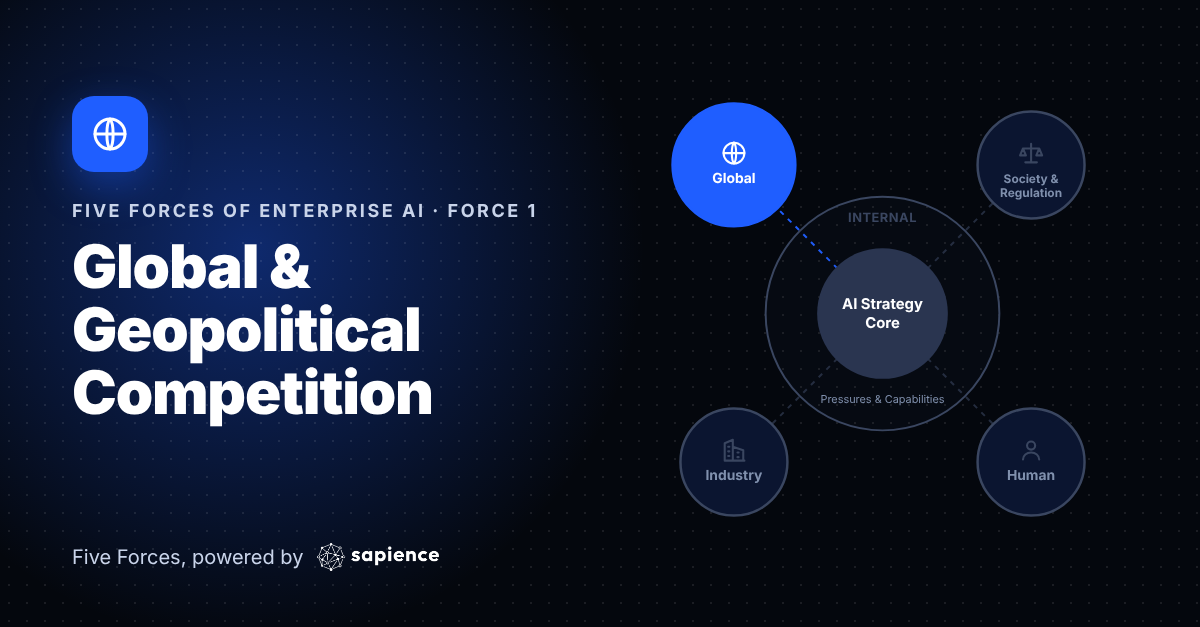 Force 1
Global & Geopolitical Competition
4 key pressures: Standards & Economic Leadership, Fostering Innovation & Trust, Culture & Regional Differences…
Read the article -
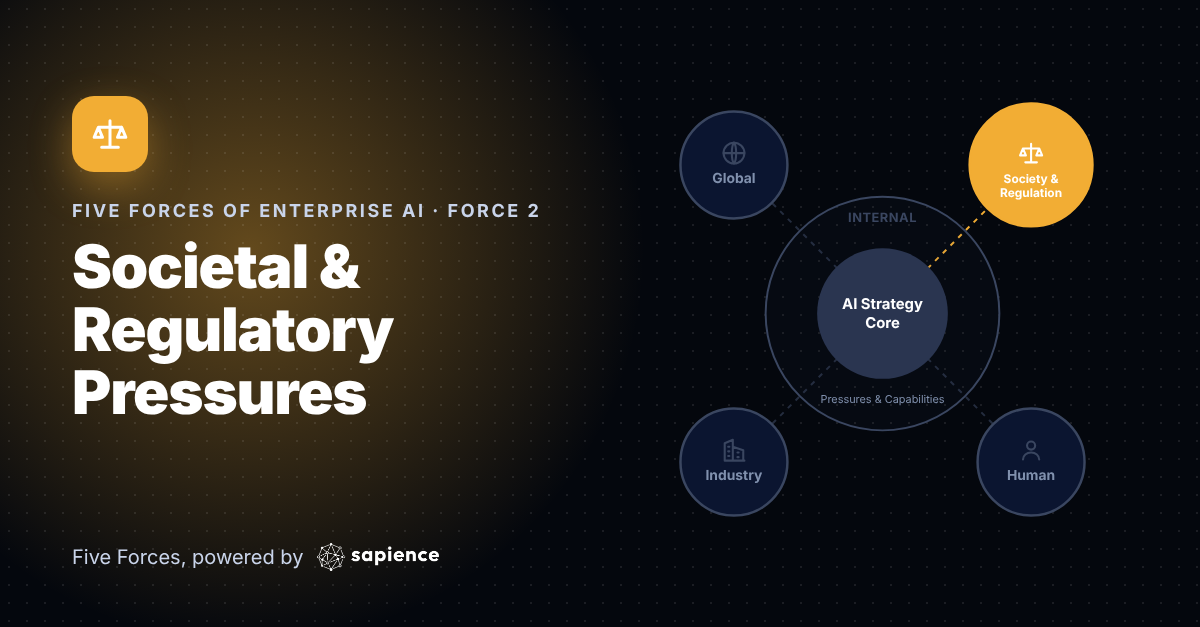 Force 2
Societal & Regulatory Pressures
3 key pressures: Conflicting Stakeholder Demands, The Velocity Gap (Tech > Regulation), The Cost of Trust
Read the article -
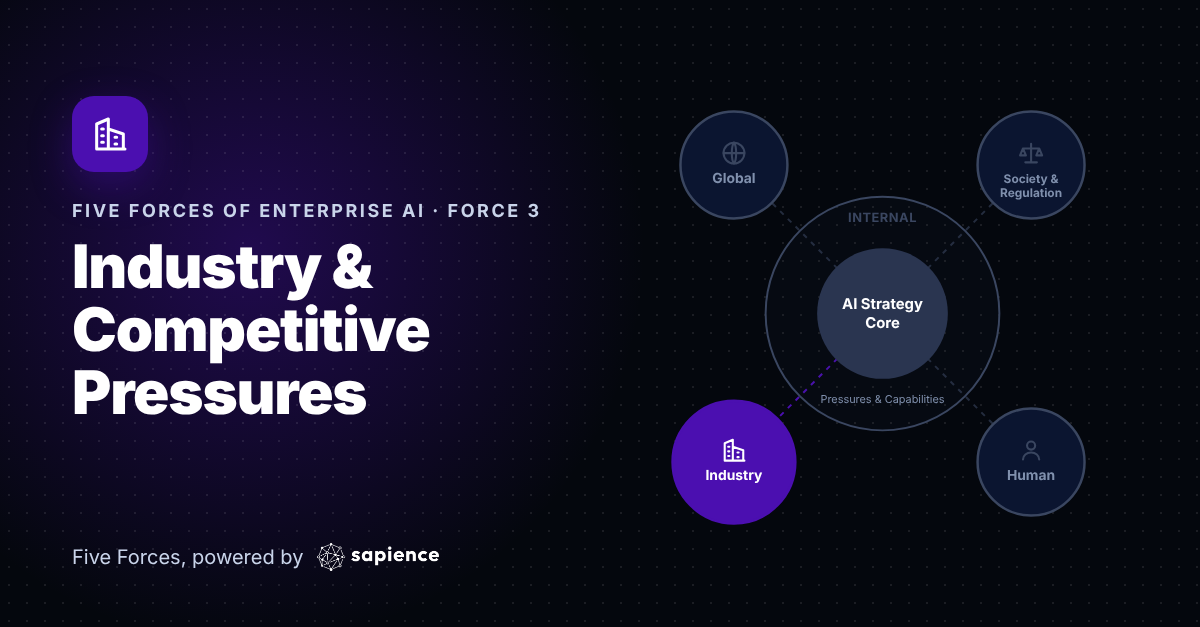 Force 3
Industry & Competitive Pressures
4 key pressures: Technology Advances & Adoption, Speed, Efficiency, & Scalability, Increased Experimentation…
Read the article -
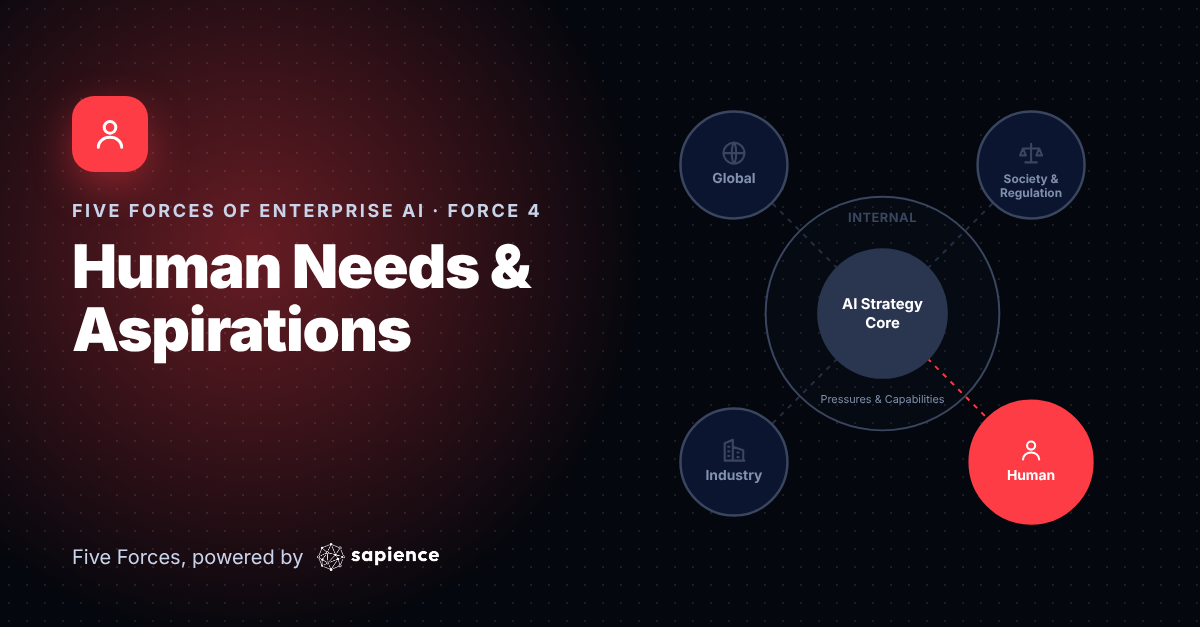 Force 4
Human Needs & Aspirations
4 key pressures: AI Literacy & Skills, Human Desires & Goals, Employment & Income Needs…
Read the article -
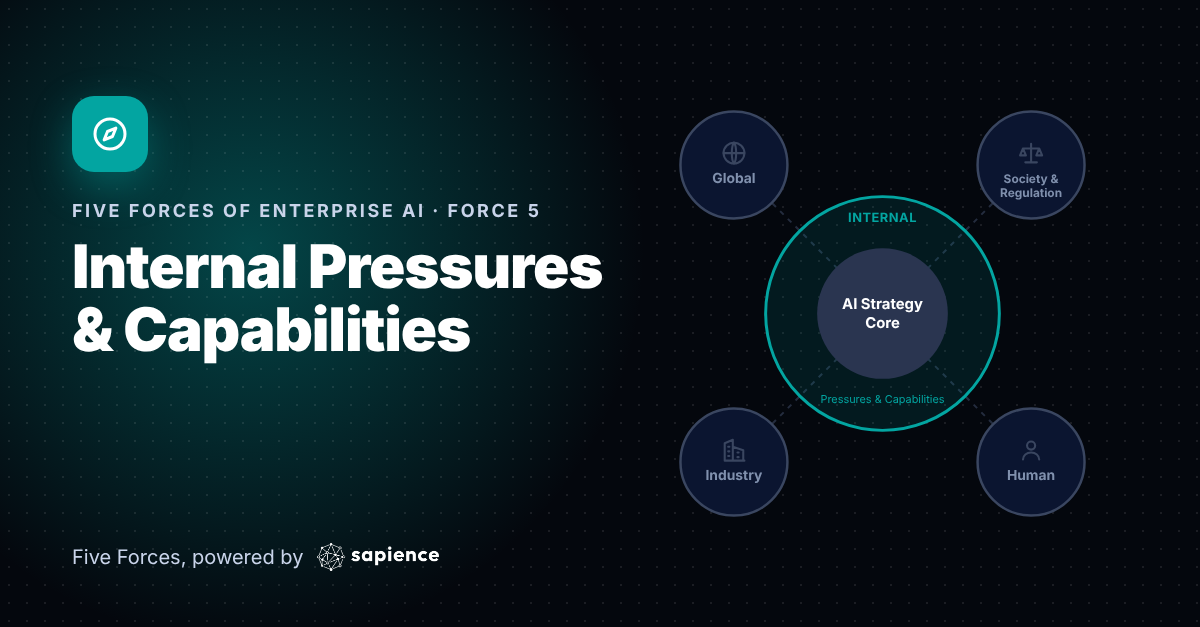 Force 5
Internal Pressures & Capabilities
5 key pressures: Leadership & Strategic Vision, People & Culture, Technology & Data Capability…
Read the article -
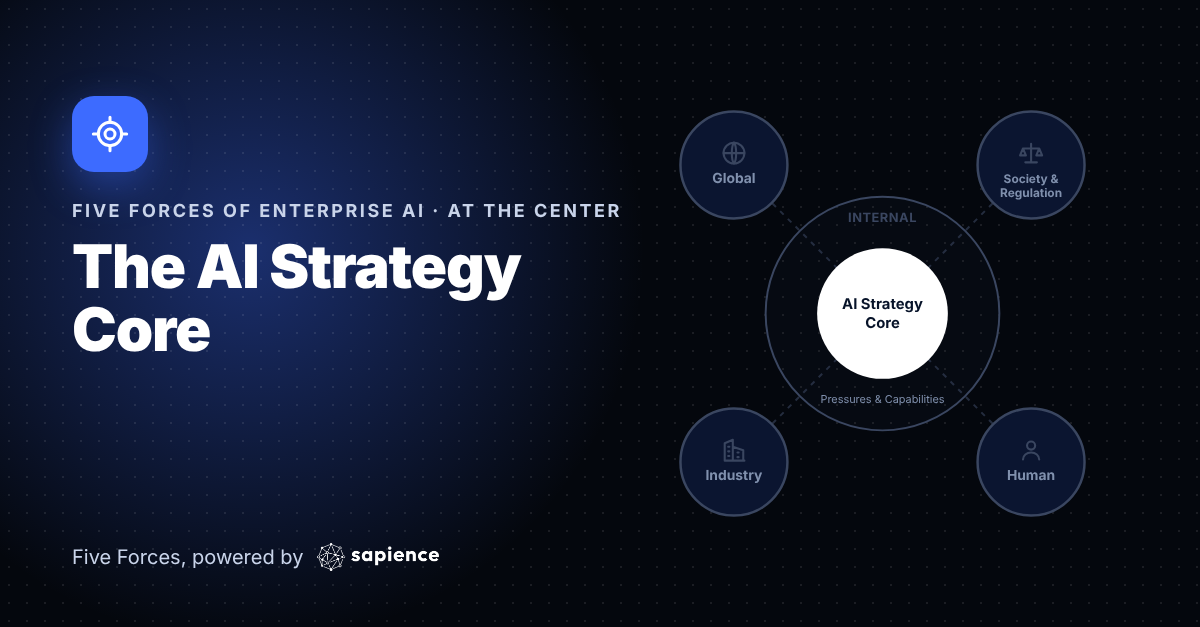 At the center
The AI Strategy Core: Defining your AI Strategy
Where your AI strategy sits: at the center of the five forces.
Read the article
Powered by Sapience
Map the Chaos. Master Enterprise AI.
Use the Five Forces of Enterprise AI to map your organization's AI readiness and chart the right strategy
GlobalGlobal & Geopolitical Dynamics
- Standards & economic competition
- Fostering innovation & trust
- Culture & regional differences
- Ethics, security, privacy, intellectual property
IndustryIndustry & Competitive Pressure
- Technology advances & adoption
- Speed, efficiency & scalability
- Increased experimentation
- Customer preferences
Society & RegulationSocietal Regulatory Pressures
- Adoption with compliance
- Technology outpacing regulation
- Regulatory, consumer, employee & interest groups
HumanHuman Needs & Aspirations
- AI literacy skills
- Human desires and goals
- Employment & income needs
- Workforce & labor supply changes
FAQ
Got Questions? We've Got Answers.
What is Five Forces?
A framework for building an AI strategy that holds up. It maps every pressure shaping how your business adopts AI, four from outside and one from within, and puts your AI strategy at the center. The assessment shows where you stand today, so you know where to act first. Five Forces is powered by Sapience, and its aim is simple: AI that shows up in your numbers.
Is this related to Michael Porter's Five Forces?
Yes, in spirit. Porter’s Five Forces, first published in Harvard Business Review in 1979, taught a generation of leaders to look past their direct competitors when setting strategy. We apply the same idea to AI and widen the lens. Porter treated technology and regulation as background. Here they are forces in their own right, next to your industry and your people. We also add what his critics said was missing: your organization’s own capabilities, and the leaders who make the call.
What are the five forces?
Four come from outside your organization:
- Global: geopolitical shifts, global standards, cross-border AI competition.
- Society & Regulation: governance, compliance, privacy and ethics.
- Industry: competitive disruption, customer expectations, sector change.
- Human: talent readiness, culture, leadership mindset.
The fifth is Internal Pressures & Capabilities: leadership and vision, resources and agility, technology and data, brand and reputation, people and culture. It weighs what your organization wants against what it can realistically do.
What sits at the center?
Your AI Strategy Core. Five Forces treats AI strategy like software. You set a direction, execute, learn from the results and adjust, again and again. Three dimensions shape where you land:
- Idea or execution. AI has made execution cheap, for you and for your competitors.
- Automation or augmentation. Efficiency keeps you in the game. Augmentation is where lasting value comes from.
- Time horizon. How far ahead you plan, and how fast you expect to move.
Why look at forces so far outside my business?
Because distant events now land quickly. When DeepSeek released its model, share markets moved and the tools available to every business changed within weeks. A strategy that only watches direct competitors will miss what reshapes its market next.
What will the assessment tell me about myself?
Your AI archetype and your AI literacy.
There are six archetypes: Explorer, Steward, Drifter, Guardian, Optimizer and Architect. Each comes with its own strengths, blind spots and risks. None is better than another, and yours can change over time.
Literacy is measured in four areas:
- Critical Judgment: can you tell when AI is wrong?
- Risk & Governance: do you understand what can go wrong?
- Strategic Literacy: do you see what AI means for the business?
- Implementation Reality: do you know why AI projects fail?
Why start with myself rather than my company?
Because AI amplifies whoever uses it. Give the same tools to two different leaders and you get two very different results, since strengths and gaps grow together. Knowing your own starting point tells you where to aim before you set direction for anyone else.
Can I assess my organization too?
Yes. The Organization Assessment looks at your business across all five forces. Complete both to compare you and your organization, and find out whether your AI ceiling is you or the business.
How long does it take, and when do I get my report?
About 15 minutes, though some people take a little longer. Your report is written from your answers and emailed to you when it’s ready. If it hasn’t arrived, check your spam folder.
What is the Five Forces Canvas?
A one-page tool for getting facts and ideas out of documents and people’s heads so a team can work on them together. Fill in the four external forces, then your internal reality, then your AI strategy in the middle. Build your first Canvas around where you are today. It becomes the baseline you measure progress against.
Who is behind Five Forces?
Five Forces is powered by Sapience, the platform for AI Agents that work alongside your team. Sapience Consulting helps leadership teams turn what Five Forces reveals into an AI plan that shows up in the numbers.
What happens to my answers?
We use them to write your report and, if you agree, so Sapience can follow up. Read our privacy policy.